Property management · Payment records
RentalDesk: connecting rent invoices, payments and tenant accounts
Follow the relationship between a unit, its tenant account, rent invoices and payment records—and the exceptions a reconciliation workflow must explain.
By Muki · Published 19 November 2026 · Product case study
Attribution & evidence
RentalDesk is a Zama Systems LTD product already featured in Muki’s portfolio. This case study describes the published product workflow. It does not claim an independently verified customer outcome or sole authorship by Muki.
The operating problem
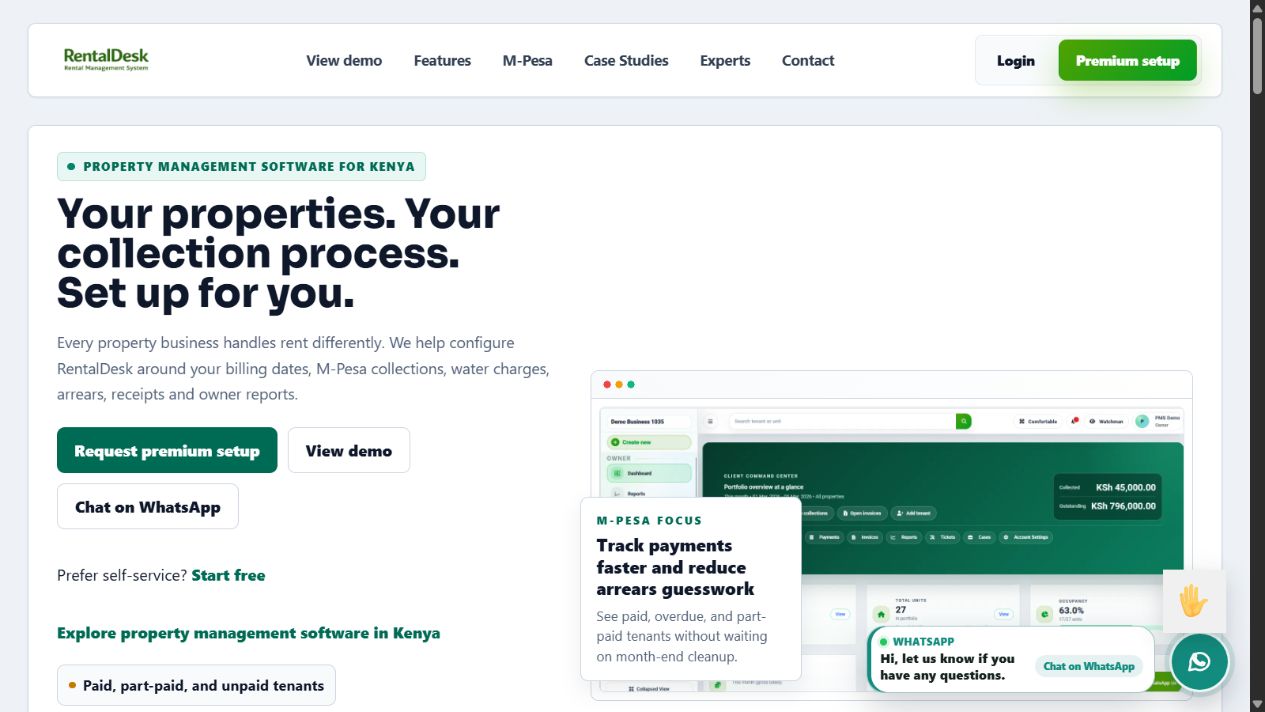
A property team needs more than a list of incoming payments. A unit belongs to a property, a tenant occupies the unit under agreed terms, and recurring charges create an account balance. When invoices, M-Pesa exports and tenant records sit in separate places, the team must reconstruct those relationships before explaining a balance. RentalDesk’s public product evidence connects these records within a property-management workflow.
How the records connect
The portfolio structure identifies properties and units. Tenant and lease records establish the billing context. Rent invoices record what is owed; payment records support receipts, statements and balance review. Arrears views then draw on that account history. The integration lesson is that a payment needs a stable destination record: its effect should be traceable from a receipt back to the invoice and tenant account.
M-Pesa collection is not the same as allocation
The published RentalDesk case study discusses matching payment references, amounts and dates while keeping unallocated activity visible. The exact connection depends on the organisation’s PayBill or payment setup and permissions. A new API does not, by itself, prove which tenant an ambiguous receipt belongs to. Reference rules, approval rights and exception review need to be agreed as part of implementation.
What the evidence supports
The public materials support a connected product workflow for units, tenancy, invoicing, payments and reporting. They do not establish a specific customer’s matching accuracy, savings or financial results. There are no fabricated percentages or anonymous success stories here. A prospective implementation should establish its own starting totals and measure unresolved payments, statement accuracy and review effort over an agreed period.
What to bring to a reconciliation review
Bring anonymised examples of a normal receipt, a partial payment, an incorrect reference and the statement your team expects to produce. Identify who owns the billing records and who may approve allocation changes. The first deliverable should be an agreed mapping and exception checklist, followed by a controlled pilot that reconciles back to the original records.