Retail operations · Payments and inventory
Vega POS: connecting checkout, M-Pesa, stock and accounts
Explore why a payment integration must fit the sale, receipt, stock and accounting workflow rather than stop at a successful checkout prompt.
By Muki · Published 19 November 2026 · Product case study
Attribution & evidence
Vega POS is an existing project in Muki’s public portfolio. This product case study is based on its published features and demo entry point. It does not present a named retailer engagement or independently measured customer results.
The operating problem
A retail payment belongs to a wider transaction. Staff need to know which sale it settles, whether a receipt is due and how the sale affects stock and customer balances. If the payment tool and inventory application disagree, a cashier may see money received while the business records still show an unpaid or incomplete sale. Vega’s published product offering places these concerns in a shared POS and business platform.
The published integration surface
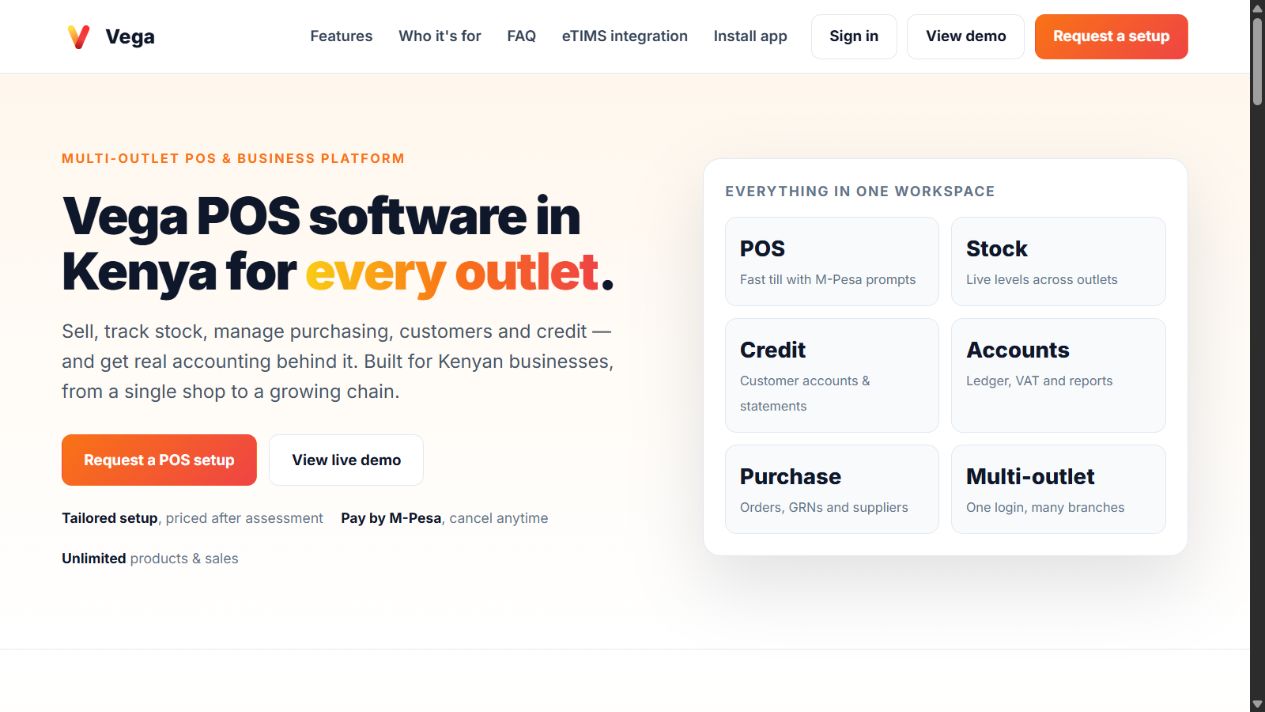
Vega publicly describes M-Pesa STK prompts and callback reconciliation alongside point of sale, inventory, purchasing, customer credit and accounting. Its public demo provides an entry point for examining the product, subject to the current demo configuration. The evidence is a product capability statement, not a guarantee that a particular merchant account is approved for every API or integration.
Why the sale reference matters
The design lesson is to preserve a clear relationship between the sale and its payment attempts. An initiated STK prompt should not be treated as a paid receipt. Final provider outcomes, repeated callbacks, cancellations and partial payments need explicit handling. A deployment review should establish how these states affect the sale, stock and ledger; the existence of a payment button is not enough to establish those controls.
Assess the complete workflow
A useful demonstration follows an order through checkout, payment confirmation, receipt, stock movement and the relevant reports. It should also cover a cancelled prompt, a repeated notification and a sale paid by more than one method where supported. The merchant’s software configuration and payment permissions determine what can be enabled. Acceptance checks belong in the rollout scope rather than in an unsupported marketing promise.
Evidence boundaries and next steps
This case study does not claim that Vega reduced a retailer’s losses, increased revenue or saved a measured number of hours. Such claims need a baseline, customer permission and verifiable results. For your business, start by identifying the authoritative sales and stock records, payment-account owner and required reports. Then agree a pilot and assess its totals against your existing controls.